
|
|
Located in the Bloomsbury area of London, the British Museum is the location of a national collection of science and art treasures. It first began in 1753 when Parliament purchased the collection of Sir Hans Sloane (the Cabinet of Curiosities) and a collection from Sir Robert Cotton along with Sir Robert Harley's Library. First opened to the public in 1759 in Montague House, it was later moved to its present location, being built in stages from 1823. The famous domed Reading Room was built in 1857 and is now part of the glassed-in Great Court.
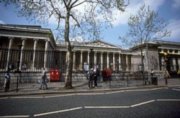 The British Museum's mandate is "to illuminate the histories of cultures for the benefit of present and future generations". Thus, the number and subject of the exhibits and galleries is vast. Ranging from Africa, Asia, the Americas, and Europe to ancient Egypt, Greece, and Rome, and back to pre-historic times, they highlight more than just Britain. A visit to the Museum is a visit through the centuries of mankind and what he has left behind of himself.
The British collections trace the history of Britain and cover prehistoric times, Roman Britain, medieval and later Britain, and Graphic Arts. One of the highlights of the pre-historic era is the preserved body of Lindow Man, dated the mid-1st century AD. The Stone Age collections include works of art and jewellery dating from 35,000 to 10,000 years ago. Roman Britain is typified by early Christian objects and collections of Roman coins. The history of the Roman Empire and society in Europe is included in such famous objects as the Portland vase, made of cameo-glass and dating from BC 1-AD 1.