Normandy

The quintessential image of Normandy is a lush, pastrol reegion of apple orchards and corn,cider and pungent cheese-but hte region also spans the windswept beaches of the Contenti and the world baks of the spine valley. Highlight inlcude the great abbey vhurches of cean, the moghty island of Mont-St-Michel.

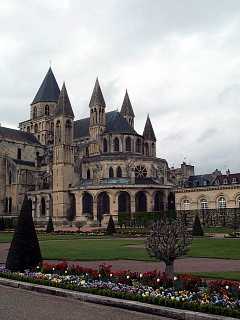
Abbaye aux Hommes

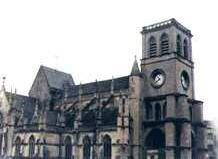
The city of Caen first became important under the Norman dukes in the 10th and 11th centuries and was the capital of lower Normandy under William I. William I the Conqueror and his wife Matilda founded two monastic communities in Caen, the Abbaye-aux-Hommes (dedicated to St. Stephen) for men and the Abbaye-aux-Dames for women. Both churches, associated with the respective monasteries, are good examples of Norman Romanesque architecture. The severe facade of Saint Étienne is logical and clear. Buttresses, which run the height of the facade, break the wall into three bays just as the small string courses divide the front horizontally and mark internal stories. The tall towers of the facade are a Gothic addition.

Cherbourg

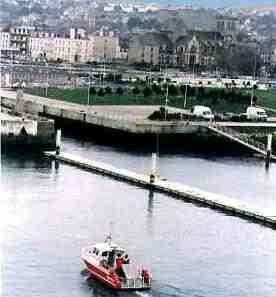
Continue on the N 13 north and reach our destination for the moment: CHERBOURG, population 90,000, occupying the northern point of the Cotentin peninsula. Visitors to Cherbourg wil today find little sign of the illustrious port where Napoleon resolved to re-create the wonders of Egypt. The simple fishers village was to be transformed into a naval base and developed also a rome as transatlantic port with grand terminals built to receive the prestigious liners that docked here and between the two world wars. Cherbourg is also still the gateway to the English Channel. The "Cap de la Hague" to the West and the "Pointe de Barfleur" to the East are markers well know to mariners. Cherbourg and its suburbs are the focal point of the peninsula. Countless artists and writers were inspired by the region's authentic and picturesque scenery. Even if Cherbourg doesn’t appear as a city full of touristy spots, it’s the city itself you have to discover. Discover the stunning coastal views on the many walks available, visit the various carefully selected attractions and places of interest or simply enjoy the local food and wine in fine restaurants. Cherbourg is open to the world and totally geared towards the future. From a social point of view, the nearness of the sea helps create open-mindedness and friendship. In fact, the warmth and hospitality of Cherbourg’s inhabitants is a well-known phenomenon. Also, as in any big open-minded, dynamic and attractive city, Cherbourg is home to a variety of different communities and cultural traditions. You see, Cherbourg is one of the most likeable and unpretentious of the Channel ports The historic part of the town is located in the area where the Général de Gaulle serves as a central square and market venue. The basilique St-Trinité was built en 1155 on the foundations of a previous church, destroyed by the Norman invasions. For shopping and strolling, head to the pedestrian section and narrow streets to its north, like the Rue Tour-Carrée and Rue de la Paix. And if it starts to rain you can shelter in one of the numerous pubs and bars, there where you start to “feel” the Cherbourg life. Don’t forget that it is, after all, a sea harbour. In the rue Vastel, south of the General de Gaulle square, the “Musée Thomas Henry includes a miscelanny of fine art with Flemish painting and a Pieta by Nicolas Poussin.


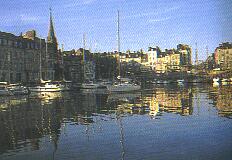
Honfleur Port

Honfleur

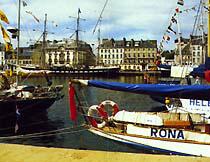
Honfleur became an important strategic point in the Hundred Years War when Charles V fortified it. The Saint-Etienne church was built from 1419 to 1450, now housing the Musée de la Marine. It was occupied by the English whose ultimate departure was finally celebrated with the building of the wonderful wooden church and picturesque belfry of Sainte-Catherine at the heart of the old town. This church is the most original monument in Honfleur. The interior reminds us of an upside down boat with two naves. Just behind the clock tower lays the RUE DES LINGOTS, one of the most characteristic of old town. It conserved its pavements, and most of its wooden houses are ancient. Look at no.30, the house where general Bonaparte, then first consul, stayed for a while. Quebec citizens should know that it is from Honfleur that Samuel Champlain set sailing from. The town commerce boomed with shipbuilding and surrounding salt marshes gave the town a commodity to trade on. On the quai de la Tour you can still see salt stores with impressive oak roof timbers, put up by Colbert, minister of Louis XIV, who greatly improved the port, adding the VIEUX PORT, top of the hit-parade on postcards and calendar pictures, around which the town is centred today.. The narrow houses lined on the quay, slate roofed, are packed one upon each other, sometimes seven stories high with only two front-windows. The curious edifice built on the riverside is the only remnant of the old town wall: the LIEUTENANCE. It used to be the residence of the king’s lieutenant. It’s on its wall that you can see the plaque commemorating the departure of Champlain to Quebec.


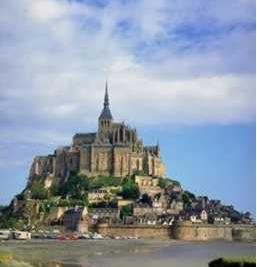
Mount St Michel

Le Mont-Saint-Michel, rocky, cone-shaped islet in northwestern France, in the Gulf of Saint-Malo, connected by a causeway with the mainland. The islet, celebrated for its Benedictine abbey, has small houses and shops on its lowest level. Above these stand the monastic buildings, many of which date from the 13th century and are considered outstanding examples of Gothic architecture. The entire islet is crowned by the abbey church, about 73 m (about 240 ft) above sea level.


Cambremer

- A village in Pay d' Auge

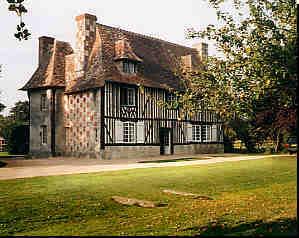
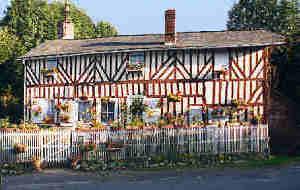
A half-timbered house in the village

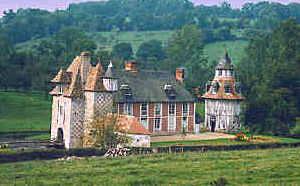
Champ-Versan' Manor


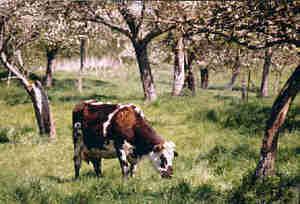
Typical Regional Landscape

Bais Manor


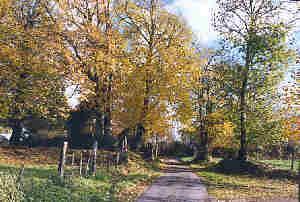
Along the "Cider Route"

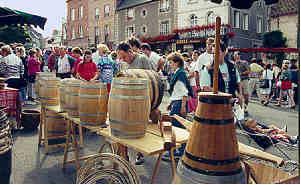
Cambremer's Old-Fashioned Market


Falaise d'Aval

The cliffs at Falaise d' Aval is famouslylikened to an elaphant dippibng its trunk into the sea

End of Page
Top · Abbaye aux Hommes · Cherbourg · Honfleur · Mount St Michel ·
Cambremer · Falaise d'Aval ·