|
|
Barcelona, located at the Mediterranean sea in the very north of the Spanish coast, is certainly
the most cosmopolitan and economically most active city in this country. It has always proved its
will to be modern, to follow the latest international tendencies or be ahead of them. To the tourist
this is evident specially in its architecture, which so well reflects the general approach to life
in this always pulsating city.
Of course, Barcelona has an old history, and there are
monuments of Romanesque, Gothic and Renaissance periods or still before, but most characteristic
is what has been built during the last, say, 100 years. Barcelona has been a center of Modernist
architecture and is distinguished specially by the works of genial Antoní Gaudí, who together with
his great contemporaries gave new and exciting looks to it, but has remained since then at the top
of modernity. If you want to find out which are the very latest tendencies today - go to discover
it here.
 Barcelona, Spain - Palau Nacional de Montijuic
|
|
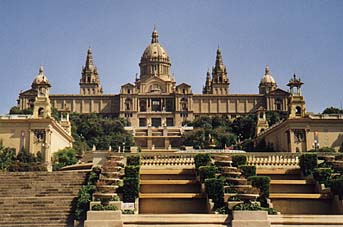
The mountain of Montjuic was the scenery of the World Exposition of 1929, for which was built the Pueblo Español. The buildings there represent all the architectonic styles typical for Spain. In 1992 the Olympic Games took place here. On top of the mountain, surrounded by beautiful parks, there is a fortress of 17th century.
Barcelona, Spain - Cathedral
|
|
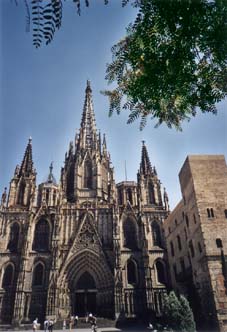
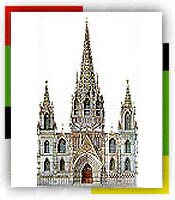
The site of the cathedral was occupied by a basilica with three naves, destroyed by Almanzor in 925, remains of which are to be found in the subsoil and can be visited, and later by the Romanesque cathedral, begun in 1046 and consecrated in 1058. The present cathedral, begun in 1298, taking advantage of elements of the previous one, consists of three naves and an apse, covered with pointed arches. Most of the church as well as the cloister was built between 1365 and 1388, under the direction of Bernat Rocam the successor ot Jacobus Fabre. Although the building was completed in mid-15C, the main facade was not built till the early years of 20C.
Barcelona, Spain - Casa Mila
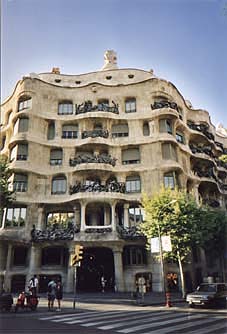
Casa mila is the most avant - garde of all the works of Antoni Gaudi. Barcelona has more Art Nouvean buildings than any other city in the world.
Barcelona, Spain - Sagrada Familia Church
|
|
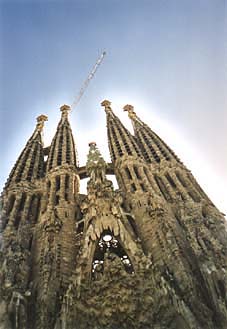
The Sagrada Familia , Gaudi's unfinished masterpiece begun in 1882, rises above the streets of the Elxample. Its polychrome ceramic mosaics and sculptural forms inspired by nature are typical of his work.
Barcelona, Spain - Las Ramblas
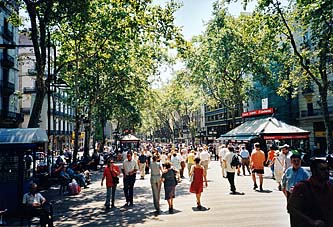
Las Ramblas is the most famous street in Spain, alive at all hours of the day and night. A stroll down its length to the seafront, taking in its palatial buildings, shops, cafes and street vendors, makes a perfect intoduction to Barcelona life. This boulevard of a length of about 2 kilometers, between Plaza de Catalunya and the port, shows what is perhaps the quintessence of Barcelona. You will find here people of any age and social class, shoe shine boys, small stands selling flowers and vegetables, street-theaters, big business-galleries, cafeterias, terraces as well as some of the great theaters of the city.
Barcelona, Spain - Generalitat Palace
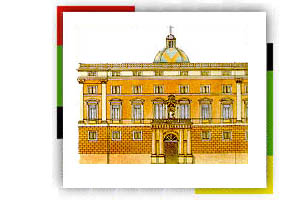
Opposite the City Hall , the palace of the Cortes, or Catalonian government, called the Generalitat, was built between 1418 and 1425. It is a group of buildings, the oldest of which is a Gothic palace, between San Honorato and Obispo Streets, with others added on by the builder Marc Safont, who was also reponsible for the Gothic facade of Obispo Street and the Capilla de San Jorge. The large staircase, surrounded by a raised gallery, was also built around 1430.