
|
|
Seville certainly is one of the most beloved places by visitors to Spain. Although today Moorish
influence is architectonically most evident - Andalusia was occupied by Moors for about 800 years -
it has been a cultural center long before. The fertility of this land and its favorised climate with
mild winters and about 3000 hours of sun per year made Phoenicians and Carthaginians settle here. Later
came Romans, like almost to any place in Europe, and two of their emperors, Trajan and Hadrian, in
fact were born here.
Also lateron Seville was the home of famous and infamous figures of history,
the legendary "Don Juan" started from here to conquer the hearts of women across all Europe, while
Columbus started from a port close to Seville to discover a new world. Prosper Merimée's "Carmen",
who couldn't make her decision between the officer Don José and the bullfighter Escamillo - the
consequences you can watch still today in opera houses - was a worker in Seville's old tobacco
factory.
 Sevilla, Spain - Plaza de espana
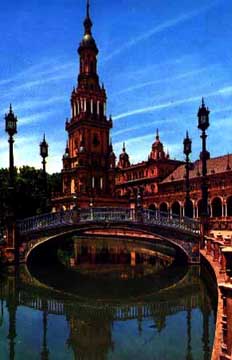
An impressive work of Seville's best known modernist style architect, Hannibal Gonzalez. It was made for the "Ibero-American Exposition 1929" and is located in the center of "Maria-Luisa -Park", forming a semi-circle around an artificial lake. The two highly individual towers at its both extremes and the great ceramic ornaments which symbolize the provinces of Spain make it one of the most characteristical buildings in town.
Sevilla, Spain - Giralda
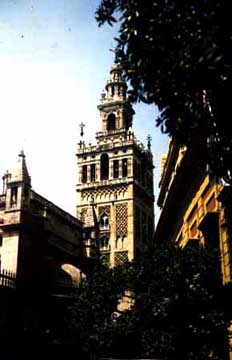
The minaret of the old Moorish mosque, today the tower of the cathedral, is this city's landmark. In the time when it was built it was the highest building in the world. Today, including some additions made by the Christians with a huge bronze statue at its top, the Giralda measures 97,5 meters. You may enjoy from here a fantastic view over all the city.
Sevilla, Spain - Alcazar
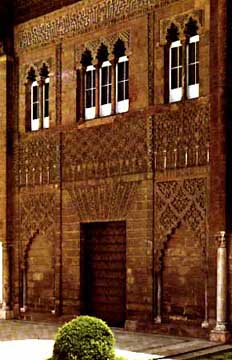
(Visits Tue-Sat 10.30 a.m. to 5 p.m., Sun 10.30 a.m. to 1 p.m., Mon closed.)
Also this
great Arabian style palace was built during various epochs. Its first fortifications probably date
of 884 and were made to defend the town of the Normans. Lateron Moorish Caliph Mohammed V.
had built here a king's palace by architects and artists from Granada and Toledo. But the major
part of today's palace was constructed after the Christian reconquest of the town in 1248, by
King Pedro "The Cruel". Another important part, Casa de la Contratación, was made after
the discovery of America. A visit is interesting in particular for the expositions of many objects
of the Moorish epoch, including a collection of musical instruments. During the summer season
frequently are performed concerts in the great gardens of the palace, which are a truly fantastic
experience to listen to. This great Arabian style palace is interesting in particular.
Sevilla, Spain - Old Tabacco Factory
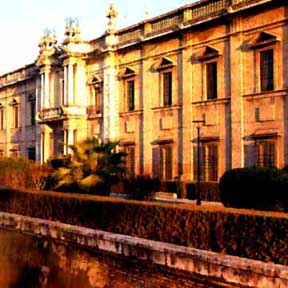
Seville's old tobacco factory became world-famous for its role in the opera Carmen. Since 1929 the building is used as University. Interesting from the artistical point of view are its portal, with sculpture works of Cayetano de Acosta and the chapel "Hermandad de los Estudiantes", with a Jesus Christ of Juan de Mesa.
Sevilla, Spain - Cathedral
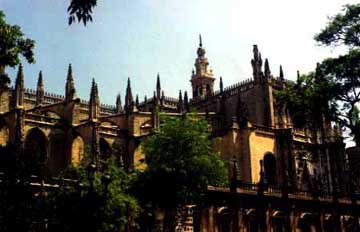
(Visits Mon-Fri 11 a.m. to 5 p.m., Sat 11 a.m. to 4 p.m., Sun 2 p.m. to 4 p.m.)
Seville's
cathedral, the third-largest in the world, has a long and moving history: over an
original Roman foundation base Goths built a temple, of which today is only conserved a small fountain
in the Patio de los Naranjos, the "courtyard of the orange trees", which itself is together
with the mighty tower, Giralda, a rest of the Moorish mosque that was built here lateron.
After the reconquest of the town by the Christians in 11th century was started the
construction of today's cathedral, work that lasted 5 centuries.
Sevilla, Spain - Hospital De La Caridad
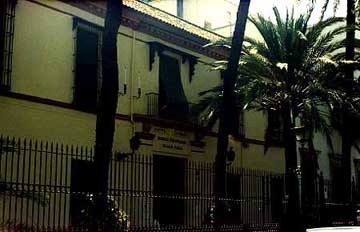
(Visits Mo-Fr 10 a.m. to 1 p.m. and 3.30 p.m. to 6 p.m., Sundays and Holidays no visits.) 17th century baroque church with an important collection of artworks, among other of Valdés Leal and Murillo. This church is of the brotherhood de la Caridad (founded in 11th century and originally dedicated to the interment of the hanged) and was restructured in 1644 by its chairman Miguel de Manara, who is said to have been the model for legendary novel-figure "Don Juan".


