|
|
| BADEN |  |
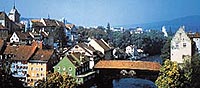
Baden has played host to the diverse people that have occupied the region. Originally Celtic, as Aquae Helveticae of the Roman it was famous for its hot springs. The town was destroyed by barbarians, but in the 13th century it was revitalized by the Austrians as a fortified town. The Old Town is dominated by the ruins of the Castle of Stein, an imposing fortress used by the Hapsburgs as an arsenal and haven during the campaign that ended in their defeat in the 14th century battles of Morgarten and Sempach. Burned and rebuilt several times, the castle as finally destroyed by the Protestants during the religious war in 1712.
Baden has been known as a vivacious spa town ever since Roman times. The richest mineral water in Switzerland gushes out of 19 springs at a comfortable 47oC. Even young people have discovered what fun it is to come and relax in the steaming open-air thermal pools here. Compared to the size of its native population, Baden has a lot of culture to offer. The town has several theatres and a large music scene. For three years now, the Musical Space dream has been playing with great success. The erstwhile meeting place of the Confederates of old has now become a modern conference and congress centre. This is located mainly at the Town Casino that also has a restaurant, a new gambling room, a dance hall and various meeting rooms. 5 Good Reasons To Visit Baden:
Beginning with Corot and Boudin, the scope of the collection includes Degas, Monet, Renoir, Pissarro and Sisley and extends through Cézanne, Gauguin and van Gogh. The unique charme of the Langmatt can be attributed to the harmony among pictures, furnishings and decorative objects. Eighteenth-century French furniture, clocks, chandeliers and carpets, porcelain, silver as well as Asiatica all serve to animate the living space. |
 BACK TO MAIN